
Veja também


 12.10.2026 08:37 AM
Bitcoin and Ether have begun the correction they had been preparing for weeks. Recall that the two most important recent developments for the crypto world were more negative than positive. Central banks (notably the Fed) have begun tightening monetary policy, which raises demand for safe assets such as bank deposits and sovereign bonds. And although demand for Treasuries has fallen globally, their yields are rising, and in the future investors could restore demand for these securities if the US government and others take measures to reduce budget deficits and sovereign debt. If capital flows to debt markets, demand for Bitcoin will fall. In addition, the regulatory Clarity Act was not passed and is unlikely to be reconsidered in the near term, as the US is preparing for congressional elections.
Meanwhile, former Strategy CEO Michael Saylor continues to urge market participants to buy Bitcoin aggressively, promising them "mountains of gold." This time Mr. Saylor said Bitcoin has entered a "digital gold rush" that will last until 2034. In effect, the ex-Strategy CEO promised the market a fabulous rise in "digital gold" over the next eight years. Saylor said the market has entered a phase of hypergrowth and that the share of digital assets could rise to 10% of total global capital over the next ten years. In that case crypto market capitalization would grow to $120 trillion from the current $3 trillion. On what basis should the crypto market increase roughly fortyfold, Mr. Saylor did not say.
However, according to the executive, large capital has begun returning to the market, and the AI sector will not "hog the blanket" forever. In Saylor's view investors are once again paying attention to digital assets, and over the next three years Bitcoin's integration into the banking sector will be the main driver.
As for Strategy, the company plans to continue buying Bitcoin, although it already owns roughly 840,000 coins. Well, it seems eternal Bitcoin growth awaits us after all — at least according to the former Strategy CEO, who always forecasts only gains for the primary cryptocurrency.
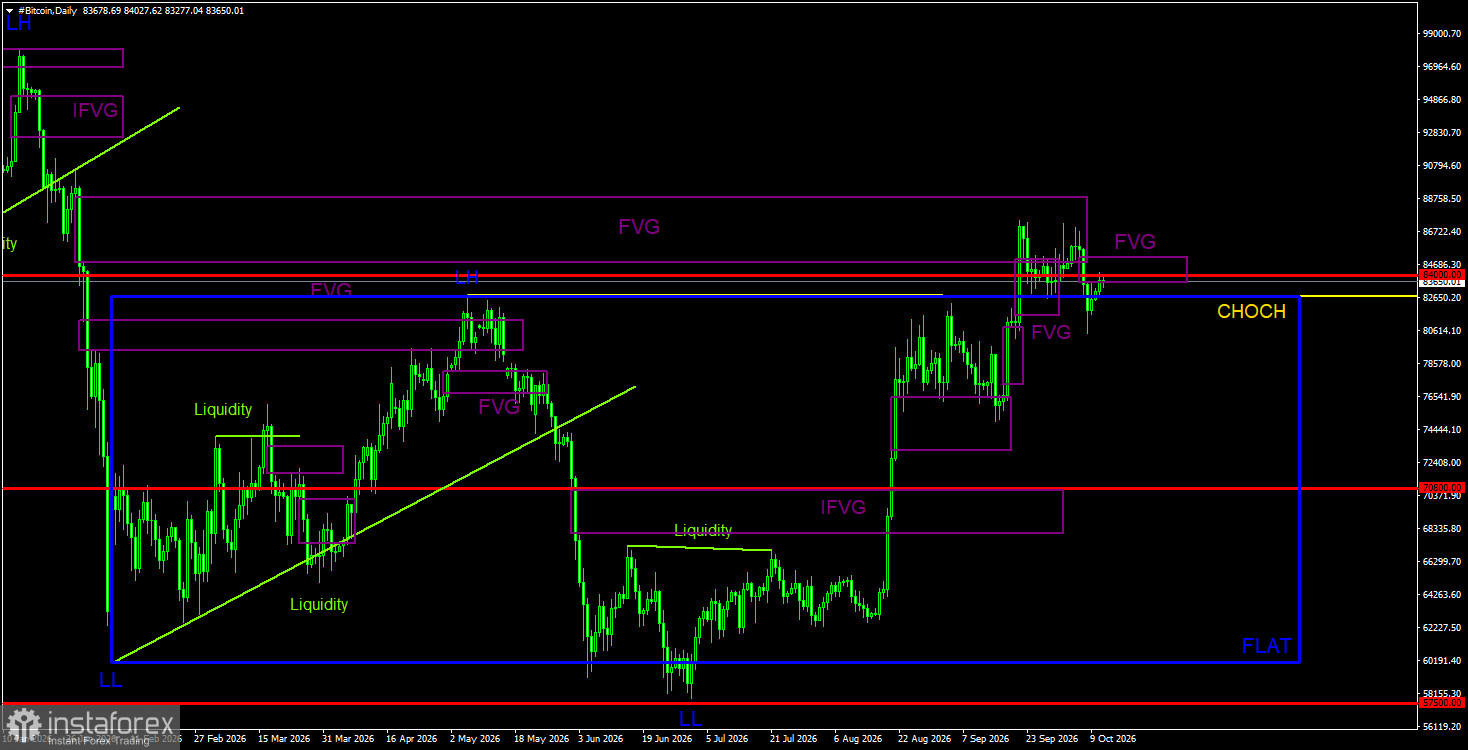
Trading recommendations for BTC/USD:
Bitcoin shows signs of the start of a new bull trend. This trend begins, as is customary, with a pump that has no specific clear reasons. The Fed has not started cutting rates, and the Clarity Act was not passed. In the near term on the daily timeframe, Bitcoin may be in decline, since the price reacted to a bearish FVG and formed a sell signal. We also note for traders that the breakout beyond the daily sideways channel may be a deviation. Although it is a deep deviation, it is still a deviation. If so, Bitcoin could head for $70,800 and even preserve the downtrend that began last year. We believe short positions are more relevant in the near term. Bearish patterns appear on both timeframes.
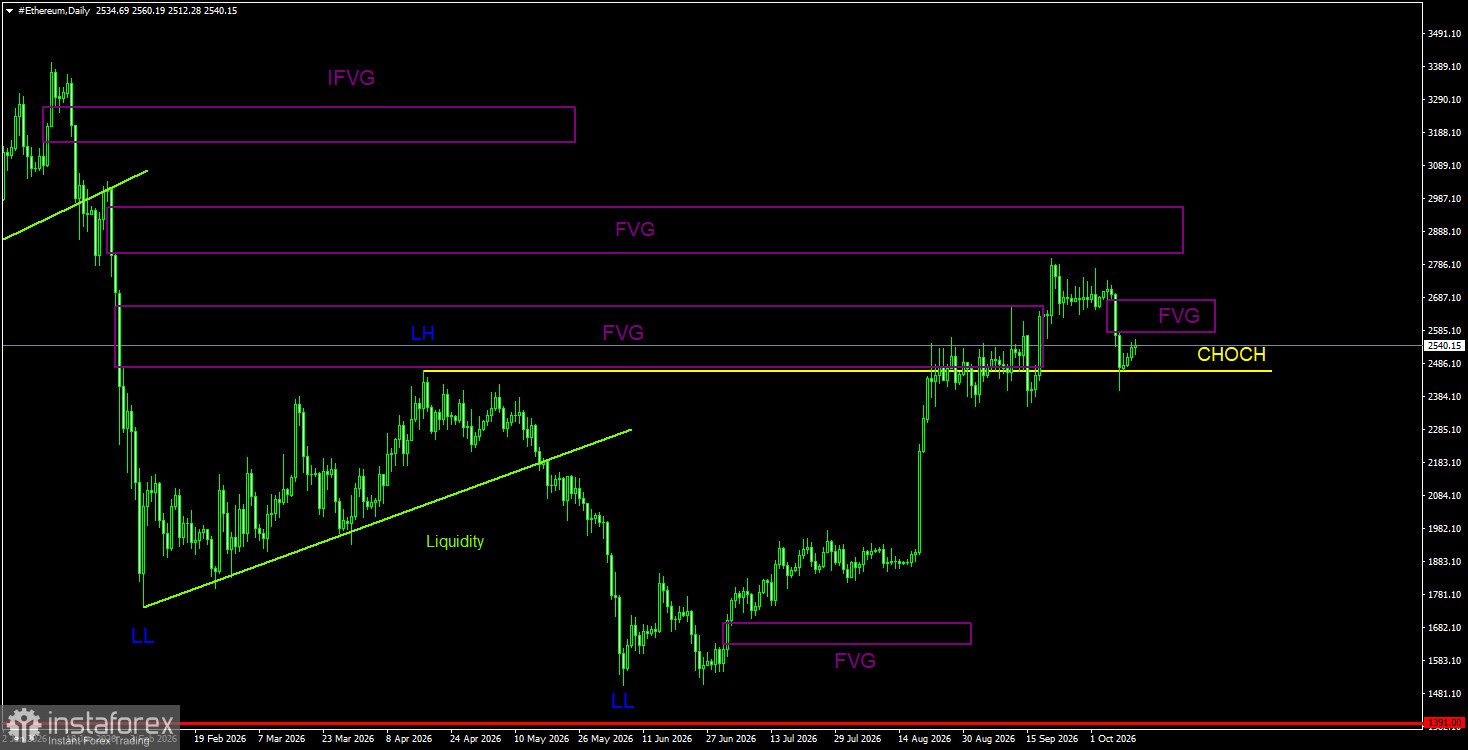
Trading recommendations for ETH/USD:
On the daily timeframe, the technical picture for Ether changed completely in just a few days. Now, Ether is oriented toward a new uptrend. However, bulls can rely only on the weekly chart, where Ether has set a course for $4,800—the upper boundary of a five-year sideways channel. On the daily timeframe, the first bearish FVG did not produce a noticeable price reaction, but Bitcoin reacted to its own FVGs, and we recall that Ether's price depends on Bitcoin's roughly 80–90%. Bitcoin began to correct, and Ether also rushed down. Thus, in the near term we expect (as before) declines. Targets for Ether may be around $2,300 and lower, down to $1,850.
Recommended reading from the author:
- EUR/USD review. October 12. Euro fails to act
- GBP/USD review. October 12. Kevin Warsh's remarks and US inflation
- Euro's problem explained by high oil prices.
- Interpretation of EUR/USD analysis results on October 12
- Interpretation of GBP/USD analysis results on October 12
Explanations for the illustrations:
CHOCH — change of character, break of trend structure.
Liquidity—liquidity, stop losses, and pending orders that market-makers use to build positions.
FVG — fair value gap, an area of price inefficiency. Price moves quickly through such areas, indicating the absence of one side in the market. Later prices tend to return and react to these areas in the direction of the main trend.
IFVG — inverted fair value gap. After a return to such an area, the price receives no reaction and impulsively breaks through, then tests from the other side.
OB — order block. The candle on which a market-maker opened a position to capture liquidity and form a position in the opposite direction.


