
یہ بھی دیکھیں


 15.10.2026 02:07 PM
While the euro is trying to show strength to the dollar, the European Central Bank may have to adopt a slightly tighter stance. That view was expressed by Klaas Knot, one of the main contenders to succeed Christine Lagarde. He said a series of economic and geopolitical shocks will produce new negative supply shocks, and the ECB will more often find itself approaching the 2% target from above rather than from below. From this he concludes the bank's policy is likely to lean somewhat toward the hawkish side.
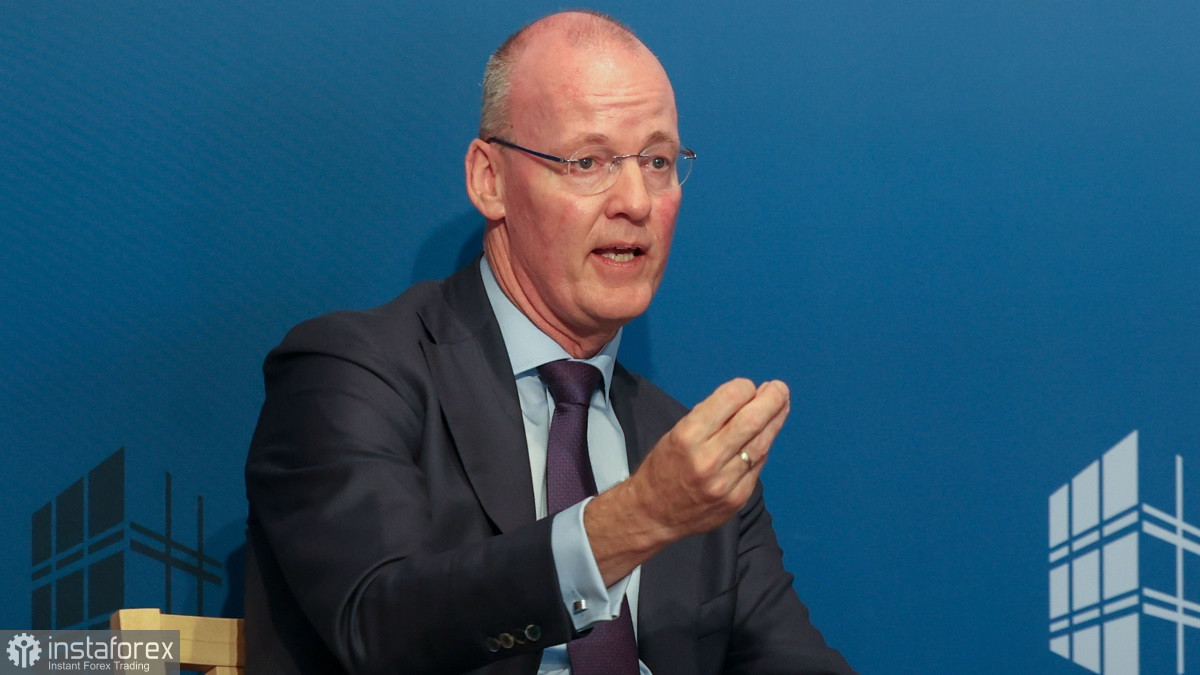
Knot, who served on the ECB Governing Council for 14 years as head of the Dutch central bank until 2025, explained his concern by pointing to financial fragmentation and surges in geopolitical risk. He expects these factors to continue producing negative supply shocks and fears they will become more frequent in the coming years. For inflation this implies a higher risk that prices will stay above target longer than markets expect. The beneficiaries of that outlook are the ECB's hawks, while those who hoped for a quick easing—and high-debt governments for whom costly borrowing becomes the norm—lose out.
At the same time, Knot called the ECB's current "balanced" stance the right approach. "You must do what is necessary, but as little as possible. The ECB enjoys very high trust, and in situations like the current one, that trust is a major support," he said.
This fits our base case. The ECB has already raised rates twice, eurozone inflation is at a three-year high and approaching 4%, and the market widely expects one more hike in December. I still view a pause at the October 29 meeting followed by a final step in
December to a 2.75% deposit rate as the main scenario, barring new data. Knot's remarks tend to confirm that scenario rather than change it, since he speaks of a steady, cautious line rather than a sharp acceleration.
Knot also sought to reassure on second-round effects. He said energy prices have been high for some time and have lifted headline inflation, but secondary effects remain very limited. He singled out January as a key month when a large share of European labor contracts is renegotiated. So far union rhetoric appears responsible and restrained, partly because people believe the ECB is serious about hitting 2%.
Technical picture for EUR/USD
Buyers now need to think about reclaiming 1.1241. Only that would allow targeting a test of 1.1275. From there one can reach 1.1310, but doing so without support from large players will be difficult. On the downside, I expect significant buying only around 1.1193. If nobody shows up there, it would be sensible to wait for a new low near 1.1156 or to open longs from 1.1117.


