
Veja também


 04.11.2026 09:24 AM
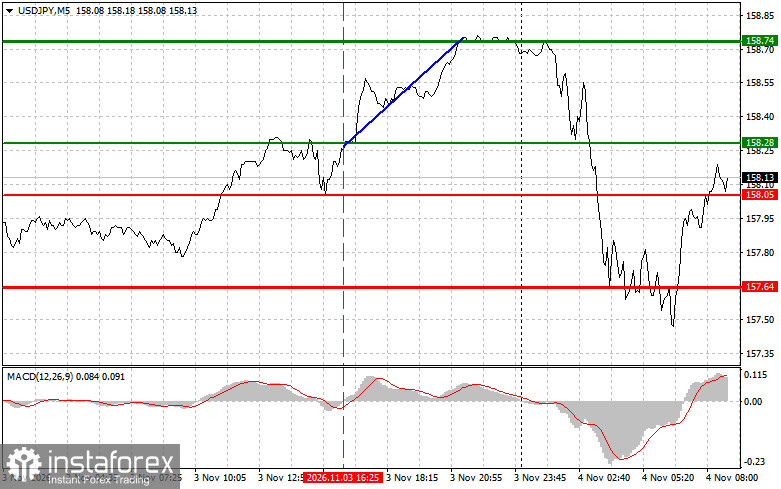
The test of the 158.28 level occurred when the MACD indicator was just beginning to move upward from the zero line, confirming a favorable entry point for buying the US dollar. As a result, the pair rose toward the target level of 158.74.
Today, the yen started the day with the release of domestic economic data, which came in slightly better than expected. Japan published its October monetary base figures, which reflect the total amount of cash in circulation and banks' reserve balances held at the Bank of Japan. The indicator contracted by 13.6% year-on-year, compared with economists' expectations for a 14.0% decline. In September, the contraction stood at 15.2%. The monetary base is shrinking because, after years of extensive monetary stimulus, the Bank of Japan is gradually withdrawing its support and reducing excess liquidity. The pace of this process is important, and it slowed in October, meaning that liquidity withdrawal was less aggressive than expected. This development is largely neutral for the yen, as there has been no sharp monetary tightening, but the data have also provided no evidence of an acceleration in policy normalization.
Developments in the US set the external backdrop for the pair. Yesterday's US labor market data were strong, leading to a decline in the yen and a strengthening of the dollar. Employers continued to maintain a substantial number of job openings, hiring remained steady, and an increasing number of workers voluntarily left their jobs. The latter is generally a sign of confidence that finding new employment will not be difficult. However, the pair has already declined sharply today, with political developments behind the move. In the midterm elections, the opposition party gained control of both chambers of Congress, changing the balance of power in Washington, although the president retained veto power and freedom of action in foreign affairs. The market reacted calmly to the results, as they were broadly in line with expectations, but they nevertheless contributed to dollar weakness. For the yen, this means additional support from a weaker US currency. As long as concerns surrounding Iran remain in the background, there are few reliable reasons to expect sharp market movements.
Regarding the intraday strategy, the main focus will be on implementing Scenarios #1 and #2.
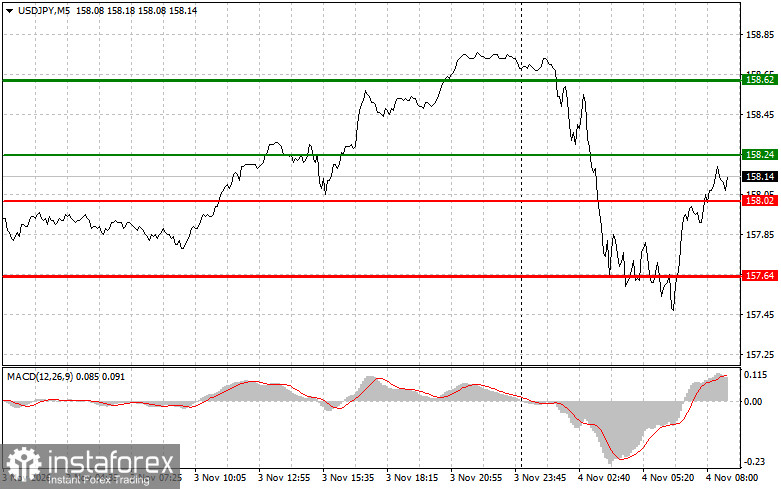
Scenario #1: The plan is to buy USD/JPY today when the price reaches the entry level around 158.24 (the thin green line on the chart), targeting a rise toward 158.62 (the thicker green line on the chart). Around 158.62, the plan is to close long positions and open short positions, targeting a move of 30–35 points in the opposite direction from that level. It is preferable to resume buying the pair during corrective pullbacks and significant declines in USD/JPY. Important! Before buying, make sure that the MACD indicator is above the zero line and is just beginning to rise from it.
Scenario #2: USD/JPY can also be bought today if the price tests the 158.02 level twice consecutively while the MACD indicator is in the oversold zone. This would limit the pair's downward potential and trigger an upward market reversal. A rise toward the opposite levels of 158.24 and 158.62 can then be expected.
Scenario #1: The plan is to sell USD/JPY today only after the price breaks below the 158.02 level (the red line on the chart), which could trigger a rapid decline in the pair. The sellers' key target will be 157.64, where the plan is to close short positions and immediately open long positions, targeting a rebound of 20–25 points in the opposite direction from that level. Sellers could return at any time; all it would take is the slightest indication of a policy shift from the central bank. Important! Before selling, make sure that the MACD indicator is below the zero line and is just beginning to decline from it.
Scenario #2: USD/JPY can also be sold today if the price tests the 158.24 level twice consecutively while the MACD indicator is in the overbought zone. This would limit the pair's upward potential and trigger a downward market reversal. A decline toward the opposite levels of 158.02 and 157.64 can then be expected.
Important. Beginner Forex traders should exercise extreme caution when making market entry decisions. Before the release of important fundamental reports, it is generally best to stay out of the market to avoid exposure to sharp exchange rate fluctuations. If trading during news releases, always use stop-loss orders to minimize potential losses. Without stop-loss orders, the entire trading account can be lost very quickly, especially when proper money management is not applied and position sizes are large.
Remember that successful trading requires a clear trading plan, such as the one outlined above. Making spontaneous trading decisions based on current market conditions is fundamentally a losing strategy for an intraday trader.


