
यह भी देखें


 12.10.2026 09:48 AM
The Elliott wave count on the 4-hour chart for EUR/USD has become more complex. On the higher timeframe (bottom chart), the downward trend segment has taken the form of a five-wave structure, A-B-C-D-E, which may be completed at any time, as it appears structurally complete. All waves within this segment are approximately equal in size, so I consider it corrective. If this assumption is correct, then once this structure is complete, an impulsive upward trend segment will begin to develop, with targets located well above the 1.2000 level.
On the lower timeframe (top chart), an impulsive wave sequence continues to develop, which may belong to wave E on the higher timeframe. If this is indeed the case, then no matter how strongly the dollar rises, its appreciation is nearing its end. A fifth wave within the downward structure may develop, as the current movement appears impulsive. However, in either case, the current wave structure suggests that the downward wave sequence is nearing completion on both charts. News developments and a sharp shift in market sentiment have triggered a strong rise in the US dollar, but each day it is becoming increasingly difficult for the dollar to continue appreciating.
The EUR/USD exchange rate remained virtually unchanged throughout Friday. A new week has begun, and the euro will once again have to defend its position, attempting to preserve at least its current levels, which are already extremely weak. In recent weeks, market participants have been buying the dollar aggressively while simultaneously reducing their exposure to other currencies. The reasons behind this market behavior continue to raise numerous questions among market participants. On the one hand, the dollar keeps rising—what more could it need? On the other hand, there is a persistent feeling that the decline could come to an abrupt halt at any moment, making it crucial to exit the market in time.
The market may well continue buying the dollar this week. Setting aside secondary events that have little or no impact on trader sentiment, the main focus is the US inflation report due on Wednesday. Forecasts suggest that the Consumer Price Index (CPI) will accelerate to 3.6–3.7%, potentially providing grounds for further US dollar appreciation. Rising inflation would mean that the Federal Reserve is moving closer to a second round of monetary policy tightening. The market has already been pricing in the first round of tightening for an entire month. Of course, FOMC policy is not the only factor driving the dollar higher, and the euro also has its own compelling reasons to attract demand. However, the market is overlooking them. If US inflation accelerates beyond the forecast range of 3.6–3.7%, this could trigger another decline in EUR/USD.
Based on all the above, the euro is likely to face another difficult week. Until the market becomes saturated with US dollar buying and begins closing those positions, it will be difficult for the euro to rise regardless of the news flow. The ECB is expected to raise interest rates for the third time this year, but this factor is currently irrelevant to the market.
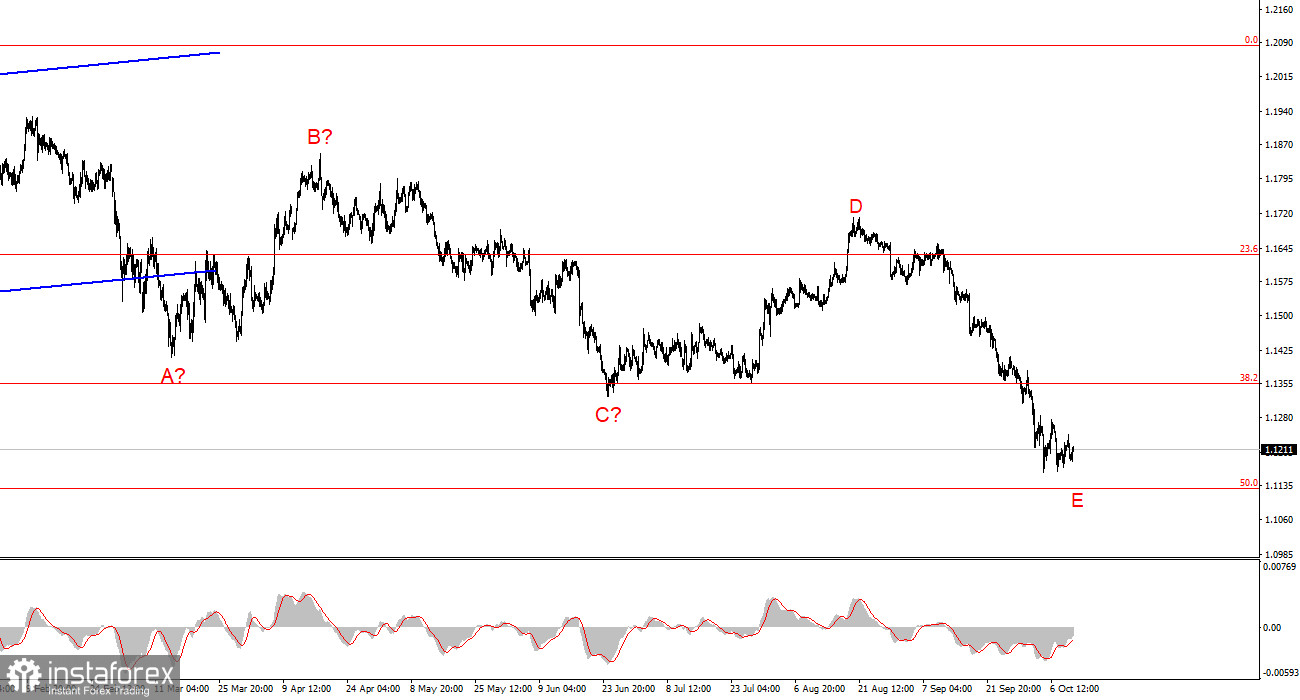
Based on my EUR/USD analysis, I conclude that the pair remains within a global corrective trend structure labeled A-B-C-D-E. If this assumption is correct, the decline will continue, with targets below the low of wave C at 1.1325. I previously considered this scenario an alternative one, and without the Fed meeting, it would have remained a backup scenario. However, the Fed delivered a surprise, leaving the market with no apparent alternative but to initiate another wave of US dollar buying. Nevertheless, the buying has continued for several consecutive weeks, even though the dollar has no new supporting factors. I would not open short positions under the current news conditions; instead, I would prepare for a potential reversal.
On the higher timeframe, a downward trend segment is visible, taking the form of an A-B-C-D-E structure. Consequently, EUR/USD may continue declining below the low of wave C, while the internal wave structure of wave E may develop into a five-wave impulsive pattern.
The Main Principles of My Analysis:

