
See also


 10.09.2026 12:40 AM
Next week the Federal Reserve will meet, and participants keep guessing what the U.S. central bank will decide. No consensus exists, and it can't. The market is torn between two factors: "Warsh is a Trump-aligned appointee, his protege" and "Warsh has repeatedly signaled a tougher stance on inflation." On the one hand, the market doubts Warsh will go against Trump, who appointed him Fed chair. On the other hand, Warsh has several times signaled his willingness to fight high inflation. Something does not add up.
Analysts at different banks also disagree. For example, Citi expects no rate change in September, arguing that a hike would push U.S. yields even higher. The Treasury, however, is trying by all means to cap yields and has boosted buybacks at least to $4bn. So the Fed and the Treasury would be pressing and braking the same car at once: the Treasury easing financial conditions while the Fed tightens them. Again, it doesn't quite fit.
UBS analysts expect two Fed hikes by year-end, saying the latest labor report allows the Fed to move to tightening. I find that argument doubtful. From May through July, cumulative Nonfarm Payrolls were only 115k. One strong August report hardly proves the end of a negative trend that began years ago and worsened under Trump. UBS also pointed to Warsh's tough Jackson Hole stance, but I remind you Warsh previously took a hard line on inflation without provoking an immediate hike. UBS admits a hot U.S. inflation report on Friday could negate their hawkish expectations because Fed policy still depends on the data.
Personally, I even doubt now that Fed policy truly depends on incoming data. We can count on tightening only if inflation exceeds market expectations and forecasts. If inflation prints 3.4% again, I think the odds of a rate rise are well below 50%. By the way, CME FedWatch shows a 60% probability — which, in essence, is close to a 50/50 proposition.
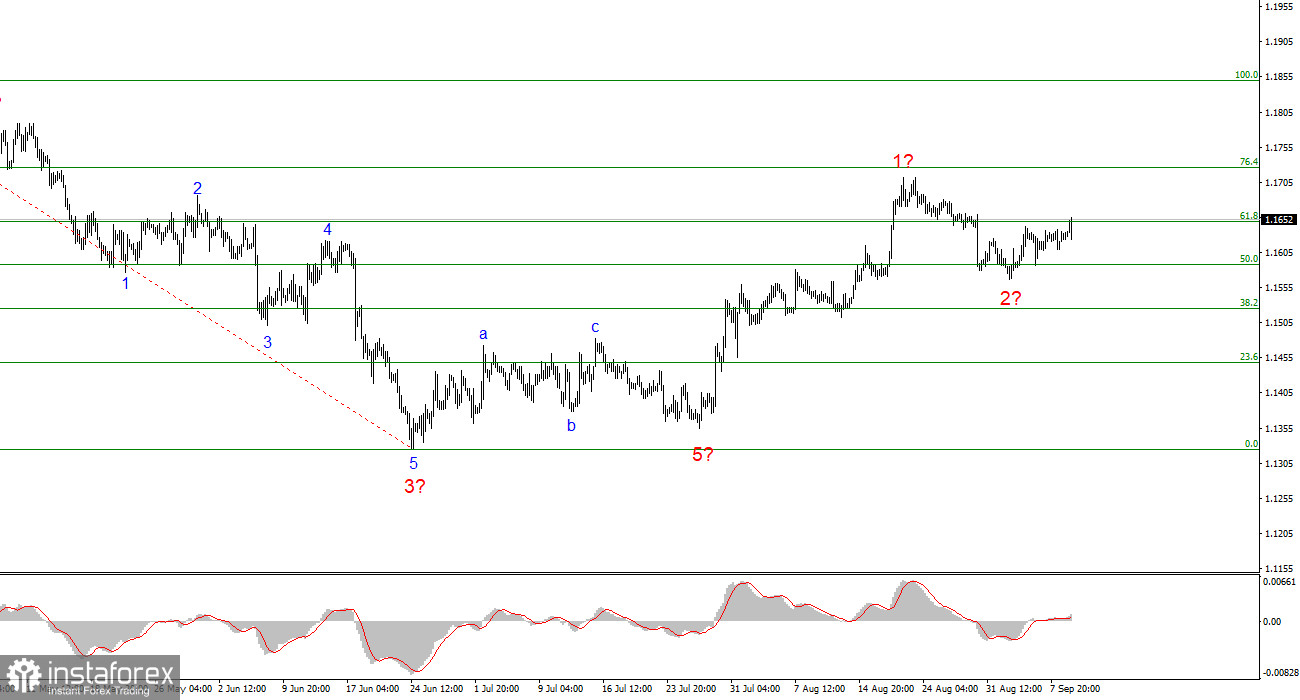
Based on my analysis of EUR/USD, I conclude the instrument remains within a local rising segment of a trend. Note the trend segment that began in January this year could still take an A-B-C-D-E shape. If that assumption is correct, prices would resume decline with targets below the low of wave C — 1.1325. I treat that as an alternative scenario. I believe a new rising trend leg began in June that will return the euro to the 1.20 area and much above it. Therefore, I remain biased toward long positions with targets above the 1.17 area.
The wave labeling for GBP/USD has become fairly clear but could be complicated. The charts show a clear corrective A-B-C structure that is complete, so I expect the formation of a rising wave sequence. If correct, sterling will continue higher toward targets above the 1.37 area. The euro is similarly predisposed to rise, and the news backdrop supports growth in both instruments.


