
Vea también


 13.10.2026 07:40 PM
Trade Analysis and Trading Tips for the Japanese Yen
The test of the 158.20 level occurred just as the MACD indicator was beginning to move downward from the zero line, confirming that it was the right point to enter a short position in the US dollar. As a result, the pair declined toward the target level of 157.95.
The yen is entering the second half of the day after strengthening against the dollar during the Asian and European sessions, despite Japanese data coming in below expectations. The focus is now shifting to US officials. Yesterday, Beth Hammack stated that restrictive monetary policy was necessary to bring inflation back to 2%, and the dollar strengthened. Today, markets are awaiting comments from Christopher Waller, as well as statements from Thomas Barkin and Susan M. Collins. In my view, their tone will determine the direction of USD/JPY. If their remarks are hawkish, the dollar could recover some of its lost ground. If they strike a cautious tone and emphasize the importance of incoming data, the yen may hold on to its gains from the Asian session. US economic releases, including the NFIB Small Business Optimism Index and existing home sales, will provide additional insight, but in my view, their impact will be more limited.
As for the intraday strategy, I will focus primarily on implementing Scenarios No. 1 and No. 2.
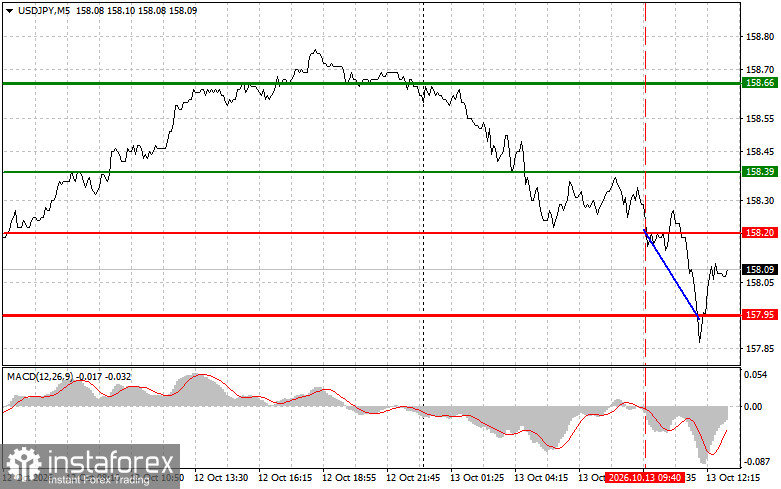
Buy Signal
Scenario No. 1: Today, I plan to buy USD/JPY when the price reaches the entry point around 158.15 (the green line on the chart), targeting a rise to 158.35 (the thicker green line on the chart). Near 158.35, I will close the long position and open a short position, targeting a 30–35-point move in the opposite direction from that level. The pair could rise today, but the upward potential is quite limited. Important! Before buying, make sure that the MACD indicator is above the zero line and has only just begun to rise from it.
Scenario No. 2: I also plan to buy USD/JPY today if the price tests the 158.01 level twice consecutively while the MACD indicator is in the oversold area. This would limit the pair's downward potential and trigger a reversal to the upside. The price could rise toward the opposite levels of 158.15 and 158.35.
Sell Signal
Scenario No. 1: Today, I plan to sell USD/JPY after the price breaks below the 158.01 level (the red line on the chart), which could trigger a rapid decline in the pair. The key target for sellers will be 157.80, where I will close the short position and immediately open a long position, targeting a 20–25-point move in the opposite direction from that level. Selling pressure on the pair could return today if the Bank of Japan intervenes. Important! Before selling, make sure that the MACD indicator is below the zero line and has only just begun to decline from it.
Scenario No. 2: I also plan to sell USD/JPY today if the price tests the 158.15 level twice consecutively while the MACD indicator is in the overbought area. This would limit the pair's upward potential and trigger a reversal to the downside. The price could decline toward the opposite levels of 158.01 and 157.80.
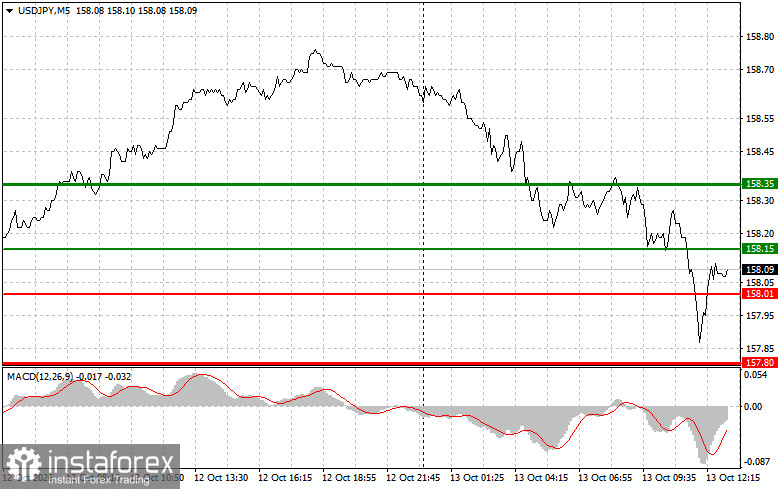
What the Chart Shows:
Important. Beginner Forex traders should exercise extreme caution when deciding to enter the market. Before the release of major fundamental reports, it is best to stay out of the market to avoid exposure to sharp exchange-rate fluctuations. If you decide to trade during news releases, always set stop-loss orders to minimize losses. Without stop-loss orders, you can lose your entire account balance very quickly, especially if you do not use proper money management and trade large position sizes.
Remember that successful trading requires a clear trading plan, such as the one presented above. Making spontaneous trading decisions based on current market conditions is a fundamentally losing strategy for an intraday trader.


