
Veja também


 10.09.2026 06:41 PM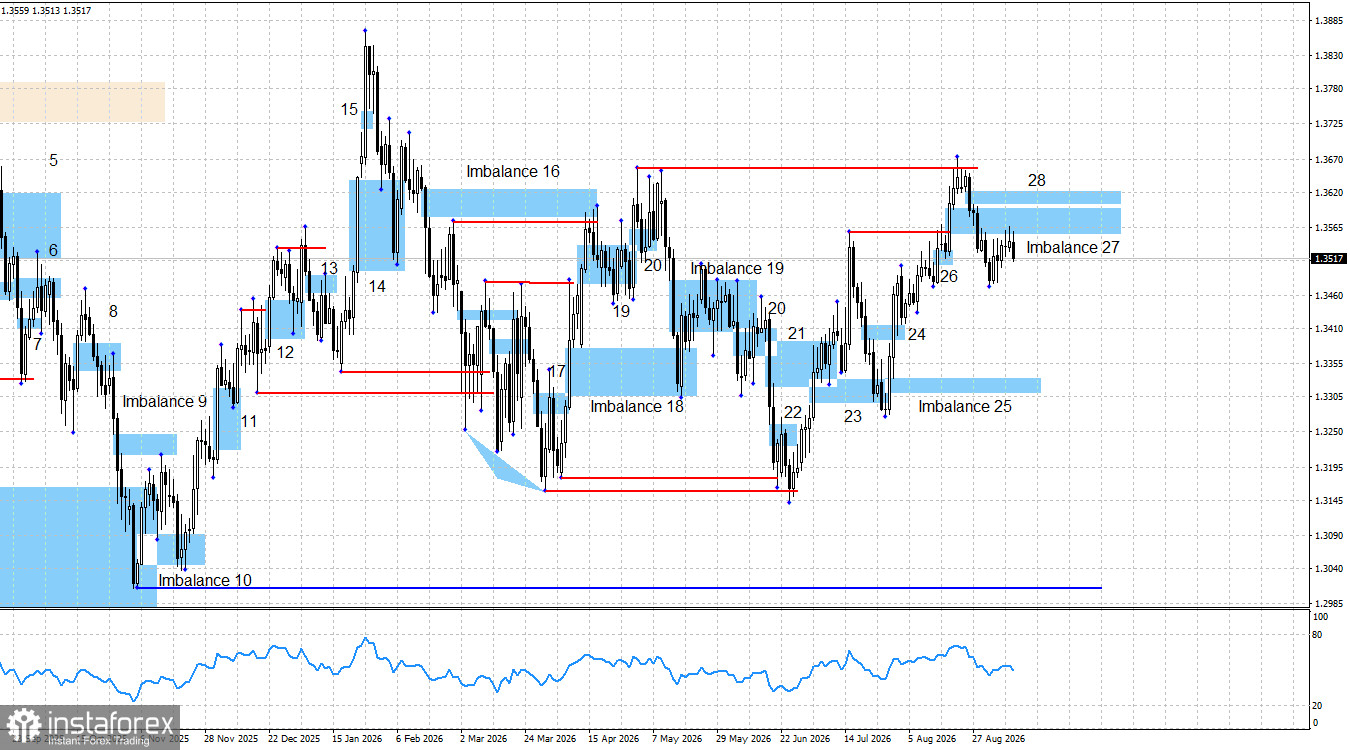
The GBP/USD pair has lost its bullish momentum, and at present the chart suggests that the pound may continue to decline. Yesterday and today, the price reacted to bearish imbalance 27, which allows traders to open short positions. This creates new, less favorable prospects for the pound. Unfortunately for the pound, further declines are indeed possible. According to analysts, U.S. inflation may accelerate in August, and this could become known as early as tomorrow. Let me remind you that official forecasts point to inflation remaining at 3.4%, but how often do forecasts coincide with the actual figure? Therefore, I consider it quite possible that the U.S. Consumer Price Index will increase, in which case the market will become even more convinced that the FOMC will tighten monetary policy next week. And if the market becomes more convinced of this, it will continue buying the dollar. In this case, the pound's decline will continue, while it remains unclear whether the Bank of England, which may also adopt a more hawkish stance than previously, will be able to support the pound. I would also note that higher U.S. inflation would appear entirely logical, as oil rose above the $100 mark this week.
Over the past month, the dollar has faced numerous adverse factors, including the U.S. Treasury's decision to increase the volume of long-term bond buybacks, weak monthly Nonfarm Payrolls reports, a weak annual Nonfarm Payrolls report, a slowdown in the Consumer Price Index, slower GDP growth, and reduced market expectations for tighter monetary policy by the Federal Reserve. The dollar was supported only by the latest Nonfarm Payrolls report (for the first time in a long while) and the ISM Services PMI. Tomorrow, the U.S. inflation report could provide support for the dollar, while next week, a hypothetical tightening by the Federal Reserve could do the same.
Do the bears have prospects at the present time? In my view, they are limited, but it should be acknowledged that the dollar is entering a more favorable period. If U.S. inflation rises following the strong Nonfarm Payrolls and ISM reports, and the Federal Reserve nevertheless decides to raise interest rates, the information backdrop for the dollar will become much more favorable. I do not believe that this would trigger a prolonged decline in GBP/USD. However, the U.S. currency could show some gains.
Geopolitics is no longer providing favorable support for the dollar. Talks between the United States and Iran have failed once again and are no longer taking place. From time to time, Iran and the United States exchange strikes, threats, and ultimatums, which has had no effect on resolving the conflict or ending the war. No one can currently predict how much longer the conflict will continue. The dollar cannot count on market support every time the two sides exchange strikes, which are occurring with considerable regularity.
Technical analysis shows that the picture changed from bullish to bearish within just a few days after liquidity was taken from the May highs. The euro may stop the pound's decline, but at present the bears have two imbalances, one of which has already provided a sell signal. Since the euro has a higher status than the pound within the euro-pound pair, I believe the pound's decline may be short-lived. However, two events could turn the market against both the euro and the pound in the near future: the Federal Reserve meeting and the U.S. inflation report.
The economic news backdrop on Thursday was rather weak and clearly did not affect traders' sentiment. Ahead of the announcement of the ECB meeting outcome, the bears went on the offensive, and the decline continued for most of the day. Nevertheless, the ECB adopted a hawkish decision, while the result of tomorrow's U.S. inflation report remains unknown. At present, the bears cannot count on a prolonged advance.
The overall information backdrop remains such that, in the long term, I cannot expect anything other than a decline in the U.S. currency. The war between Iran and the United States has not changed my long-term expectations. Geopolitics prompted the market to remember the dollar's safe-haven status for several months, but the conflict has already passed its most active phase. The prospects for tighter FOMC monetary policy remain uncertain, while the market is constantly changing its own expectations. Therefore, in my view, any rise in the dollar is temporary and driven by short-term factors. I would also note that GBP/USD has been trading within a range for an entire year. A range allows traders to expect virtually any movement within its boundaries. Traders have so far been unable to break out of the range.
News calendar for the United States and the United Kingdom:
The September 11 economic calendar contains four entries, among which I would highlight U.S. inflation, on which traders' sentiment currently depends to a significant extent. The impact of the economic backdrop on market sentiment could be strong on Friday.
GBP/USD forecast and trading advice:
The long-term outlook for the pound remains bullish. After liquidity was taken from the two latest swings and a series of buy signals was formed, the bulls may still continue their advance. Unfortunately, however, the bears have controlled the initiative in recent weeks, and all recent bullish patterns have been invalidated. The euro may save the pound from a decline if the two latest bullish imbalances are not invalidated. The liquidity sweep from the May 1 swing allowed the decline to begin; a sell signal formed within inverted imbalance 27, and another bearish signal formed within imbalance 27 this week. Therefore, either the European patterns or the British patterns must be invalidated. I lean toward the British imbalances being invalidated, but the information backdrop can produce surprises. Final conclusions can be drawn tomorrow and next Wednesday.


