
یہ بھی دیکھیں


 19.10.2026 08:42 AM
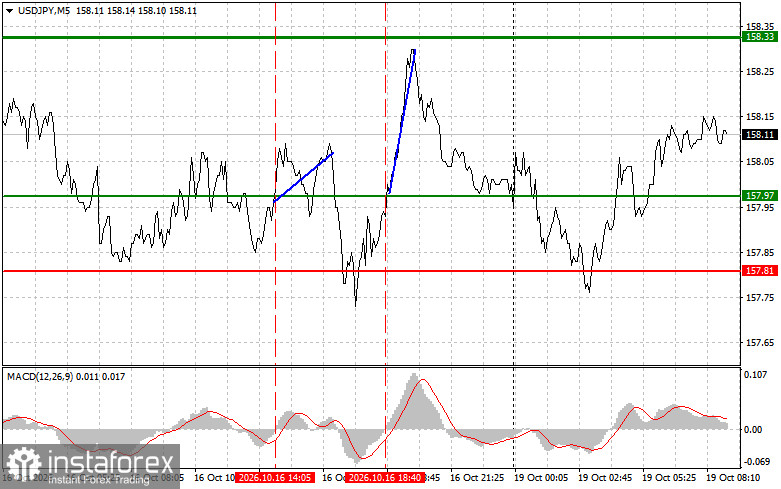
A price test at 157.97 occurred as the MACD indicator began moving up from the zero line, confirming a valid entry point to buy the dollar. As a result the pair rose toward the target area 158.33.
The yen was left in a difficult position after the US data. US industrial production rose 0.7% in September, capacity utilization reached 76.9%, and net foreign purchases of US securities in August amounted to $279.2bn versus $75.2bn expected. That boosted demand for dollars and weakened the yen.
Japanese authorities and the Bank of Japan moved quickly to calm markets. Prime Minister Sanae Takaichi rejected claims that her policies drove yen weakness and higher yields, saying the government seeks to strengthen confidence in the currency by building a stronger economy and ensuring fiscal stability. For FX markets, such assurances matter because doubts about fiscal discipline typically pressure the yen via higher yields and capital outflows, and a clear government stance reduces that fear.
BOJ governor Kazuo Ueda said core inflation is now very close to the 2% target — echoing his October 6 remarks that the economy is modestly recovering and core inflation is approaching 2%, and that rate hikes will continue though timing and pace remain open. Repeating that message reinforces expectations of further policy normalization, which can support the yen over time.
Earlier in the week, the European session saw pressure from protests in France, which increased demand for the dollar. I believe Takaichi's and Ueda's comments provide partial support to the yen, but as long as the dollar gains support from US data and the euro remains weak, USD/JPY retains a bullish bias.
For intraday strategy, I will mainly rely on Scenarios 1 and 2.
Scenario 1: Buy USD/JPY today near 158.19 (green line on the chart), targeting 158.49 (thicker green line). I will exit long positions at 158.49 and open short positions there, aiming for a 30–35 pip retracement. It is best to return to buying on corrections and significant pullbacks. Important: before buying, ensure MACD is above zero and just beginning to rise.
Scenario 2: Also consider buying if price tests 158.00 twice while MACD is in the oversold area. That would limit downside potential and trigger a reversal higher. Expect moves to 158.19 and 158.49.
Scenario 1: Plan to sell USD/JPY only after a break below 158.00 (red line). That should lead to a rapid decline. Sellers' key target is 157.76, where I will exit shorts and immediately open longs (aiming for a 20–25 pip reversal). Sellers can return at any moment — you need some hint from the central bank. Important: before selling, ensure MACD is below zero and just beginning to fall.
Scenario 2: Also consider selling if price tests 158.19 twice while MACD is in the overbought area. That would limit upside potential and trigger a reversal down. Expect declines toward 158.00 and 157.76.
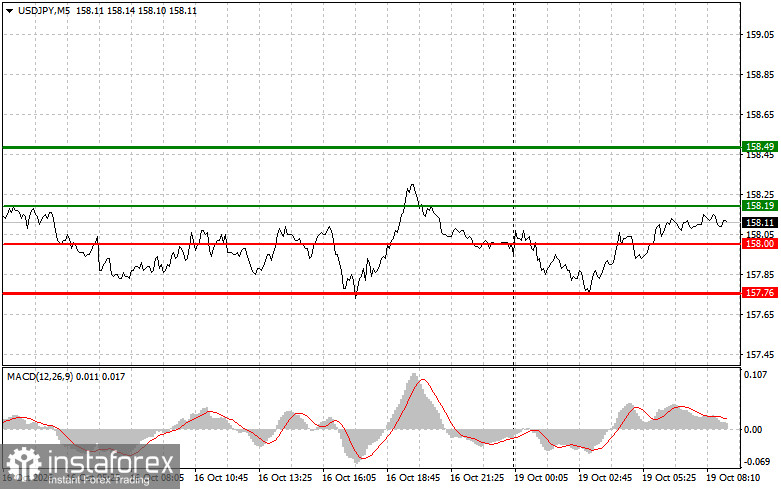
Thin green line — entry price where you can buy the instrument.
Thick green line — approximate price where you can place Take Profit or manually lock in profits, because further upside above this level is unlikely.
Thin red line — entry price where you can sell the instrument.
Thick red line — approximate price where you can place Take Profit or manually lock in profits, because further downside below this level is unlikely.
MACD indicator. When entering the market, it's important to consider overbought and oversold zones.
Important. Novice Forex traders must be very cautious when deciding to enter the market. It is best to stay out before major fundamental reports to avoid getting caught in sharp price swings. If you decide to trade during news releases, always place stop orders to minimize losses. Without stop orders, you can quickly lose your entire deposit, especially if you don't use money management and trade large volumes.
Remember: successful trading requires a clear trading plan, like the example above. Spontaneous trade decisions based solely on the immediate market situation are, by definition, a losing strategy for an intraday trader.


