
یہ بھی دیکھیں


 19.10.2026 11:45 AM
Bitcoin and Ether continue the correction they had been preparing for weeks. Recall that the last two major developments for the crypto world were more negative than positive. Central banks (notably the Fed) have begun tightening monetary policy, which raises demand for safe assets rather than Bitcoin. The Clarity Act remains only a bill. If Democrats win control of Congress, there is a real chance the bill will never become law. Thus, the fundamentals for further crypto market upside look questionable.
Meanwhile, Galaxy Digital reported that institutional trader demand has weakened significantly in 2026. Recall prior reports that spot demand remains low and futures positions are insufficient to form a sustained bull trend. Alex Thorn, head of research at Galaxy, said Bitcoin firms have also slowed their accumulation of "digital gold." Thorn examined the balance between spot-ETF purchases and buys by Bitcoin companies and concluded there is currently no basis for further "digital gold" upside. His study asked whether institutional demand today can absorb potential supply; the answer is disappointing: if large quantities of coins hit exchanges, institutions are unlikely to absorb them.
From October 1 to 16, about $615m flowed out of US Bitcoin ETFs. Thorn believes institutional interest has not vanished but remains extremely weak in 2026. Weak demand is not a recipe for success for Bitcoin. Thorn concluded that ETFs have ceased to be the vehicle through which the market can readily absorb any additional supply. He also noted that aggregate reserves held by Bitcoin companies exceed 1m coins, but large reserves do not equal strong current demand.
Trading recommendations for BTC/USD:
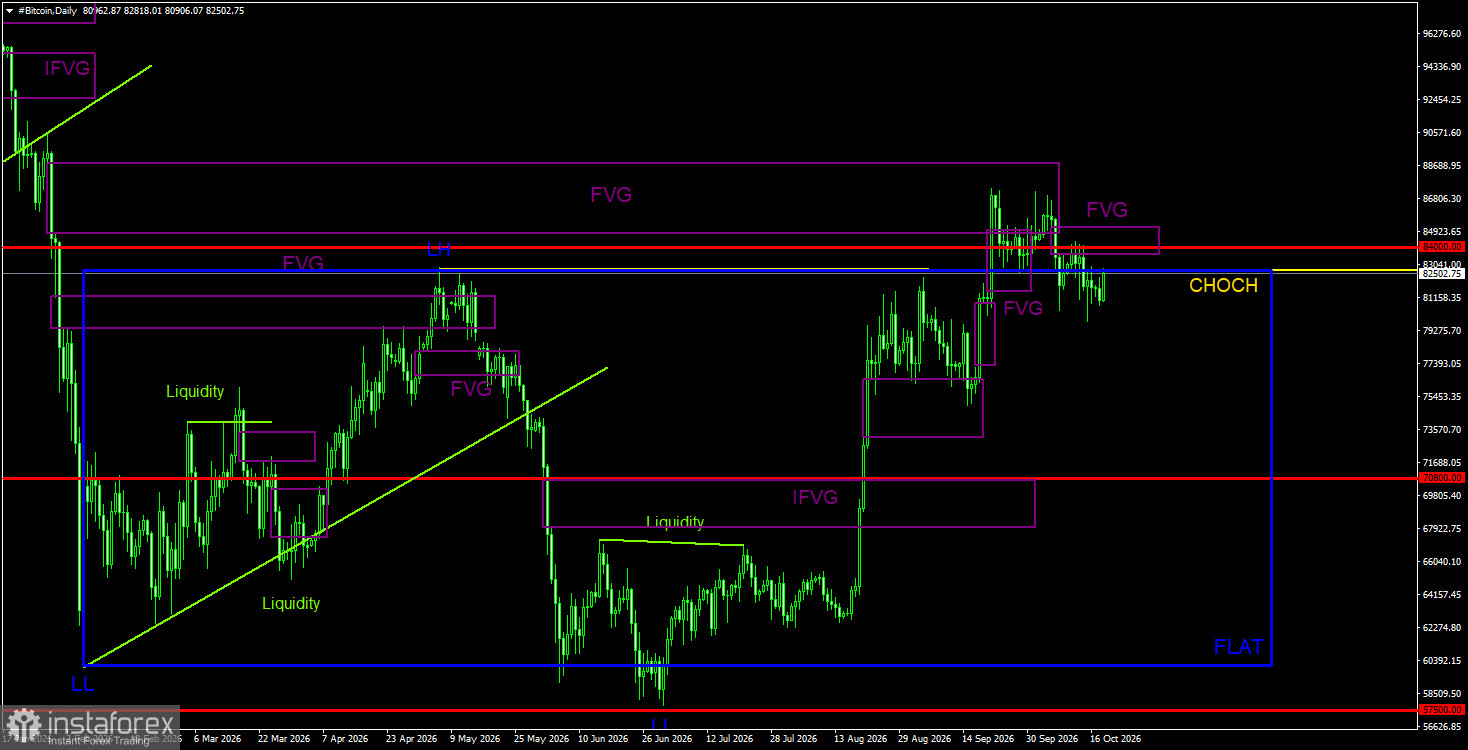
Bitcoin shows signs of the start of a new bull trend. This trend begins, as is often the case, with a pump that lacks specific, clear reasons. The Fed has not started cutting rates, and the Clarity Act was not adopted. In the near term on the daily timeframe, Bitcoin may be in decline, since the price reacted to a bearish FVG and generated two sell signals. Also note that the current breakout beyond the daily sideways channel may be a deviation. Yes, a deep deviation, but still a deviation. If so, Bitcoin could head toward $70,800 and even preserve the downtrend that began last year. We believe short positions are most relevant in the near term. On the 4-hour timeframe, be cautious near the upper boundary of the sideways channel—a deviation may form and the decline may resume.
Trading recommendations for ETH/USD:
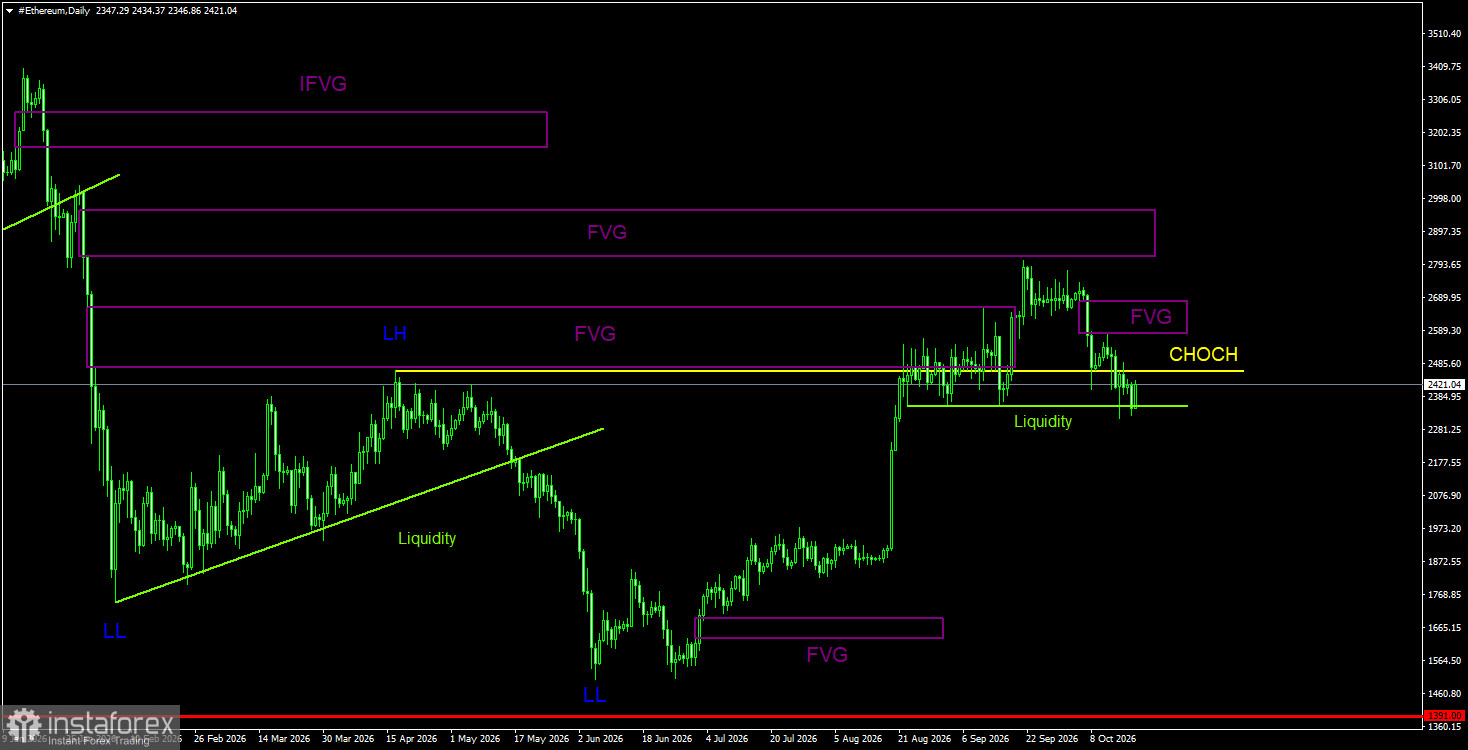
On the daily timeframe, the technical picture for Ether has changed completely. Now Ether is oriented toward a new uptrend. However, bulls can rely only on the weekly chart, where Ether has set a course for $4,800, the upper boundary of a five-year sideways channel. On the daily timeframe the first bearish FVG did not prompt a noticeable price reaction, but Bitcoin reacted to its own FVGs, and recall that Ether's price depends on Bitcoin's by roughly 80–90%. Bitcoin began to correct, and Ether also plunged. Thus, in the near term we expect declines (as before). Ether targets are around $2,300 and lower, down to $1,850. On the daily timeframe, Ether received a sell signal from the nearest FVG. Liquidity removal warns of a pause in the decline or a possible end to the downward correction. But the downward correction in Ether, given the current Bitcoin dominance index, will end only when the correction in "digital gold" ends.
Explanations for the illustrations:
CHOCH — change of character, break of trend structure.
Liquidity — liquidity, stop losses, and pending orders that market makers use to build positions.
FVG — fair value gap, an area of price inefficiency. Price moves quickly through such areas, indicating the absence of one side in the market. Later prices tend to return and react to these areas in the direction of the main trend.
IFVG — inverted fair value gap. After a return to such an area, the price receives no reaction and impulsively breaks through, then tests from the other side.
OB — order block. The candle on which a market maker opened a position to capture liquidity and form a position in the opposite direction.


