
See also


 04.11.2026 07:32 PM
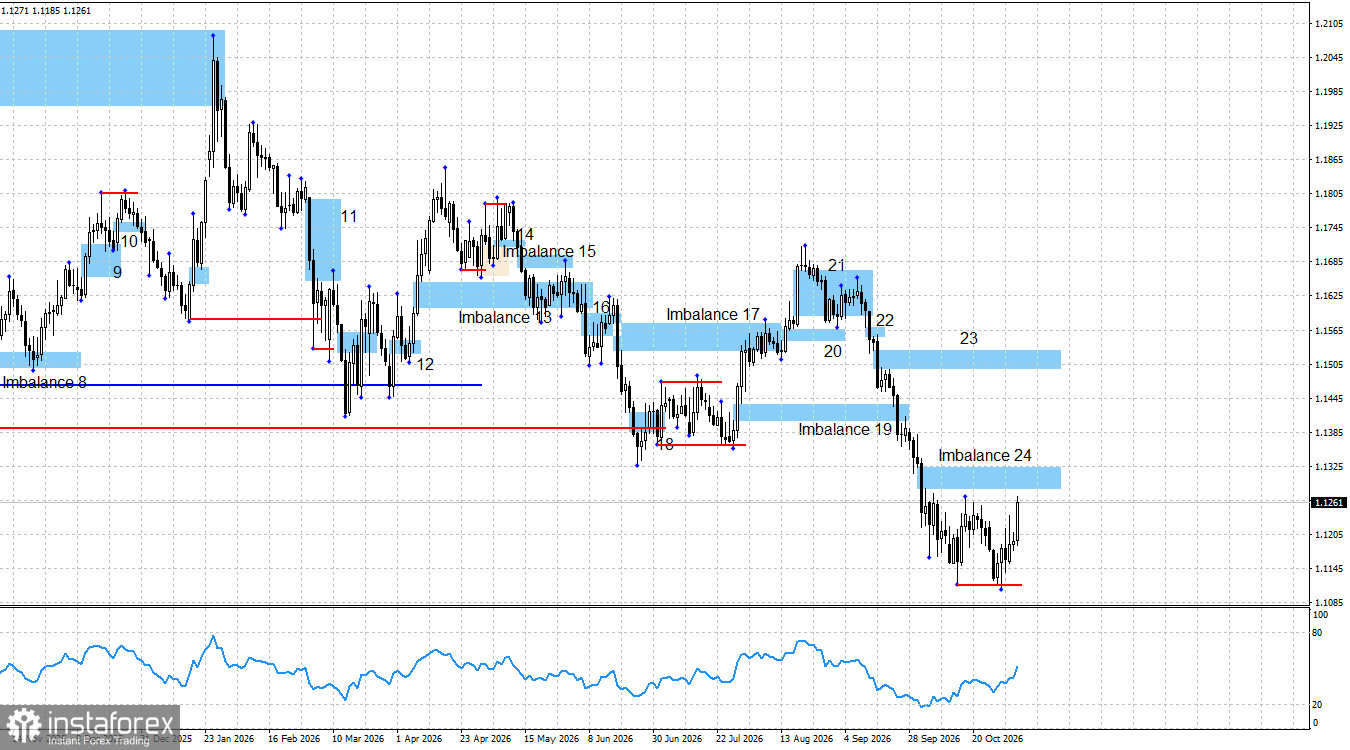
The EUR/USD pair reversed in favor of the euro late last week after liquidity was swept below the most recent low. This means that the technical conditions for a potential recovery in the European currency have emerged, and I continue to expect the bulls to launch a full-scale offensive. In my view, the bears have been on the attack for too long and with too little resistance, while the news background over the past few months has not been so one-sided as to justify the dollar's continued gains. The euro deserves at least a corrective pullback. It also has an obvious target: Imbalance 24, from which the bearish impulse could resume, potentially generating a sell signal. Therefore, traders should closely monitor price action around Imbalance 24 in the near term.
Today, the news background favored the bulls. It has repeatedly supported the European currency over the past two months, although this has not been reflected on the charts. However, everything eventually comes to an end. Today, it became known that the Republican Party suffered a crushing defeat in the elections and that inflation in the European Union accelerated to 4%. Both developments favor the euro. The US Congress will now be divided, making it difficult for Democrats and Republicans to reach an agreement. As a result, many important government decisions may now face significant delays. Higher inflation in the European Union points to further monetary policy tightening by the ECB, which is also a bullish factor.
I would like to remind readers that one of the main reasons behind the dollar's gains over the past two months was the Fed's hawkish stance. However, in reality, it is not as hawkish as many believe. At the latest meeting, only two FOMC members voted in favor of tightening policy, while the Fed itself adopted a neutral stance. This did not warrant the dollar's dominance over the euro in recent weeks. The US economy grew more strongly than expected in the third quarter, but the EU economy also outperformed forecasts. The ECB left interest rates unchanged, and it is also expected to raise them in December, just as the Fed is. The economic conditions facing the euro and the dollar are currently almost identical.
At present, I do not see a single sign that the bearish offensive is coming to an end. Imbalance 24 remains valid, and the price could react to it, potentially generating a sell signal. The bulls need to invalidate Imbalance 24 and form bullish patterns if they hope to achieve even a modest recovery. This would require a sharp upward move in the euro, which we finally saw today. As early as Thursday, the market could form its first bullish pattern in a long time.
In September, the FOMC raised interest rates and signaled its readiness to begin tightening monetary policy. This was enough to trigger a large-scale bearish offensive that has continued ever since. However, even after the Fed's monetary policy tightening in September and the possibility of another tightening move in December, I do not believe the euro has gone without a single piece of positive news during this period.
Overall, in my view, the news background continues to favor the bulls. Although the Fed has adopted a more hawkish monetary policy stance, this is not the only factor determining exchange rates. The European Union also has its problems, but that is precisely the point: problems exist everywhere, yet only the euro is falling. Both central banks are tightening monetary policy, but only the dollar is gaining. Nevertheless, I would not recommend expecting the euro to rise before bullish signals emerge. Nor would I recommend buying the European currency in advance.
The current technical picture indicates that the bearish impulse remains intact. The only relevant pattern at present is Imbalance 24, which could come into play in the near future. The bulls have gained some opportunities for a recovery following the liquidity sweep and the strong possibility of a bullish imbalance forming this week.
On Wednesday, the economic news provided the bulls with an opportunity to launch a powerful attack, and they finally took advantage of it. EU inflation accelerated as expected, while the US election results increased political and economic uncertainty. I do not even see a reason to discuss the remaining reports.
The bulls still have plenty of reasons to attack in 2026. Structurally and globally, Trump's policies—which led to a significant decline in the dollar last year—have not changed. At present, I see no major factors supporting the US currency, despite the FOMC's hawkish stance.
Economic Calendar for the US and the European Union:
- US – Initial Jobless Claims (13:30 UTC).
- European Union – Speech by ECB President Christine Lagarde (15:00 UTC).
On November 5, the economic calendar contains two events, neither of which I would consider particularly important. The impact of the economic news on market sentiment on Thursday may therefore be limited.
EUR/USD Forecast and Trading Tips:
In my view, the pair remains in the process of forming a bullish trend that has been undergoing a corrective pause for an entire year. The news background shifted sharply in favor of the bears eight months ago, but the trend, which has been in place for four years, cannot yet be considered invalidated or complete. The bulls may resume their advance before the end of the year, but their only meaningful opportunities at present are the low of 1.1066 established in June last year and the low of 1.1114 established several weeks ago. Liquidity was swept below the latter, triggering the bulls' offensive. However, a new sell signal could form within Imbalance 24.


