
আরও দেখুন


 15.10.2026 02:07 PM
Bitcoin and Ether trade near weekly lows and show no signs of strength, and they may well fall further. Bitcoin holds near $81,000, Ether near $2,350, and yesterday's US inflation report—showing a rise to 3.7%—left the market without support: bond yields climbed, Fed hike bets returned, and buyers on the rebound are nowhere to be seen.

Today, it emerged that a very important White House figure for the crypto industry who led crypto regulation has departed. Patrick Witt, executive director of the White House crypto council, is leaving for the private sector. In his statement he called serving in the administration a once-in-a-lifetime privilege and promised to continue supporting US technological development from outside government. Recall that Witt was the White House's lead adviser on the CLARITY market structure bill for digital assets, which would have created the first comprehensive regulatory framework for the US crypto market. In September the Senate failed to invoke cloture on that bill, and no further progress is expected in the current session.
The scale of the loss is that Witt was the last remaining staffer on the council. In March the crypto and AI lead David Sacks left, in July deputy director Harry Jung departed, and earlier, in August 2025, the council's prior head Bo Hines left and within weeks became a strategic adviser to Tether on US expansion.
For the market the chain of consequences matters. The market structure bill was not passed, and the council that pushed it inside the administration is effectively ceasing to exist. That shifts regulation from the legislative level to individual agencies. Without a law, agency rules are easier to reverse after an administration change, leaving institutional investors with more uncertainty. This is one reason money is not returning to spot ETFs as quickly as desired.
Witt's departure alone will not move the price, but it confirms once again that the legislative catalyst is postponed at least until the November 3 midterms and likely beyond. Until the Fed meeting on October 28, the market will be driven by yields, oil, and ETF flows, not regulatory news. While price remains below $81,900, I expect further declines and a retest of yesterday's lows; a move back above that level would be required to negate the bearish scenario.
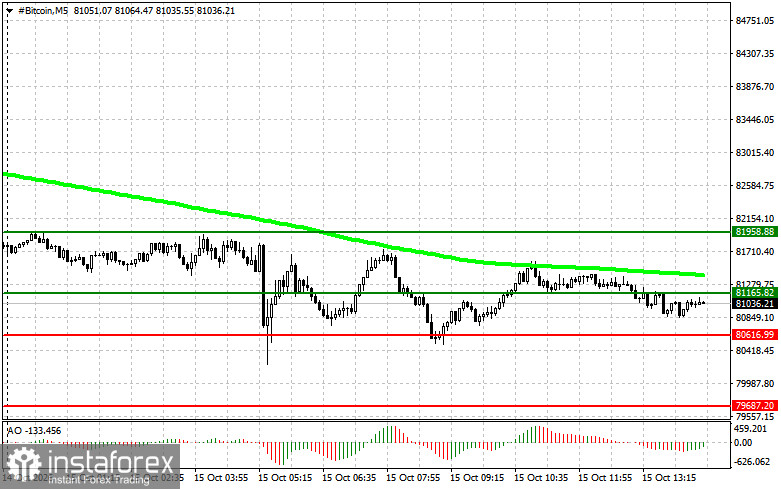
Technical analysis of Bitcoin
Price trades in a narrow corridor between support at $80,600 and resistance at $81,100, with outer boundaries at $79,600 and $81,900, and the plan is built around two mirror directions with full breakout and rejection scenarios. For long, there are two entries. First, a break above $81,100 with confirmation: buy targeting $81,900, where I would take profit and consider shorting the retracement, provided the price remains above the 50-day moving average and the Awesome indicator is above zero. Second, a bounce from $80,600 if a downside break fails and the drop proves false: buy for a return first to $81,100 and then $81,900. Sells are symmetric. A confirmed break below $80,600 gives a short target of $79,600, but only when the moving average lies above the price and Awesome is below zero. If the break above $81,100 fails and the price returns below that level, a short from resistance targets a return to $80,600 and then $79,600.
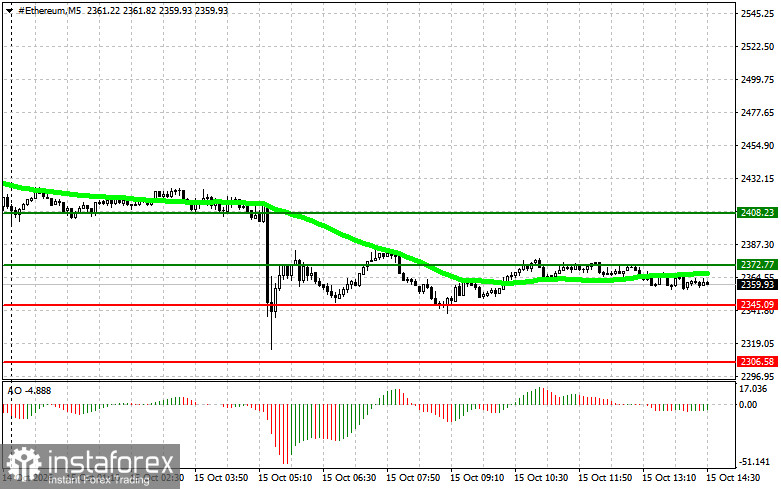
Technical analysis of Ether
The logic mirrors Bitcoin on its own price scale: an inner corridor between support at $2,345 and resistance at $2,372, with outer boundaries at $2,306 and $2,408. Buy on a break above $2,372 targeting $2,408, where profit is taken and a short on the pullback may be considered; condition as before—price above the 50-day moving average and Awesome above zero. Buy on a rebound from $2,345 if a downside break fails, with initial targets of $2,372 then $2,408. For sells, a confirmed break below $2,345 opens a short toward $2,306 provided the moving average is above price and Awesome is below zero. A rejection from $2,372 after a failed upside breakout gives a short back to $2,345 and then $2,306. Both indicators serve as filters to weed out false moves, not as standalone entry triggers, so decisions are made only after price confirms the designated levels.


